
CAIN
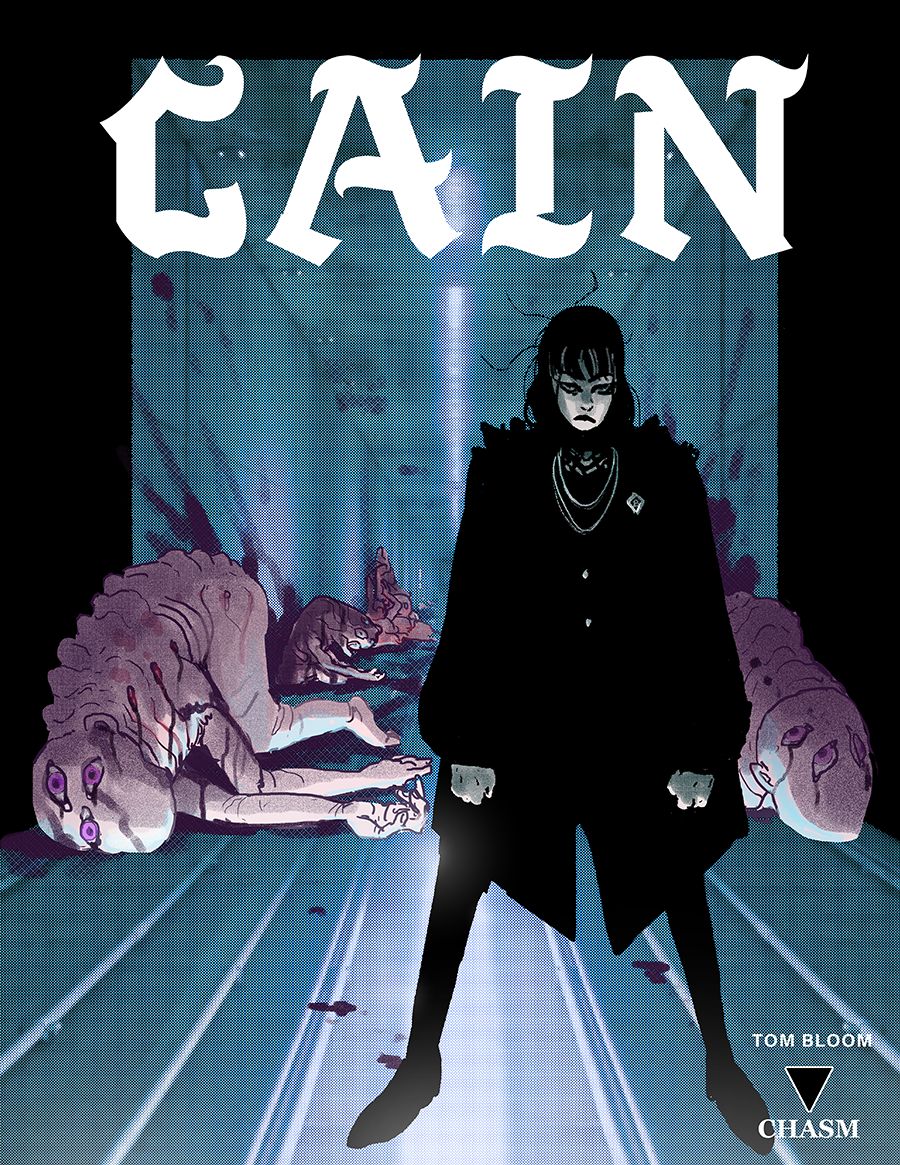
CAIN is a TTRPG made by Tom Bloom (Chasm). He was also one of the creators of LANCER, which you’ve likely heard of if you’re really into TTRPGs, and also made the comic Kill Six Billion Demons. It is directly inspired by anime/manga like Neon Genesis Evangelion, Jujutsu Kaisen, and Chainsaw Man among others, as well as the Persona and XCOM series. It also is similar to SCP. I’ve heard it described as mechsploitation without the mechs. If you like any or several of those things, you may like CAIN.
Narrative
Players take on the role of Exorcists: psychically empowered tools of the shadow organization CAIN in their war against SINS (traumas made manifest as deadly monsters).
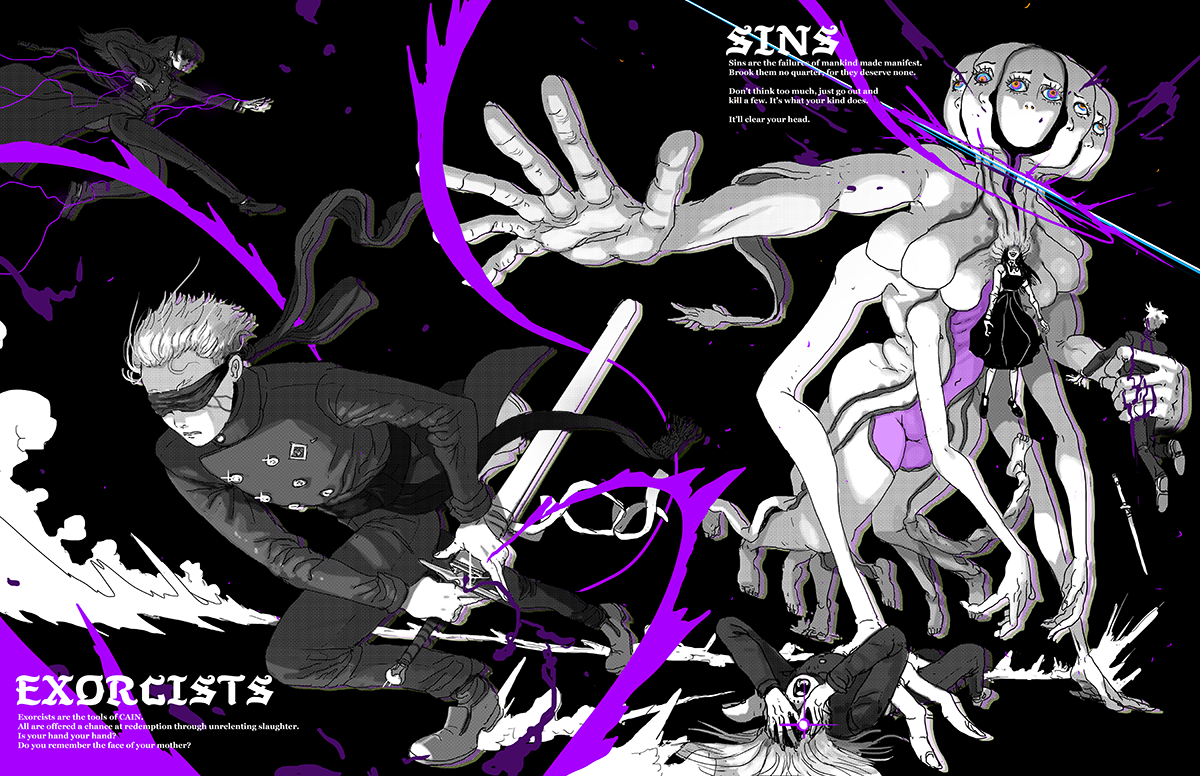
The theming lends itself well to playing on christian religious trauma by reiterating often that Exorcists are not people, and that they are strongly related to SINs, and that they must serve CAIN (involuntarily) in order to redeem themselves. In the Games for Freaks expansions (most of which are free now, all of which become free eventually), there are even established characters called Virtues which are powerful exorcists you can gain powers from by working with for several missions. I say working with, but it’s more so you’re working with the tenets they espouse. It’s more like following in the footsteps of a specific saint, though it can sorta play out however. They all have art and since Tom Bloom drew it they’re all beautiful and made to appeal to bisexuals, so some groups may have them be more involved on a personal level.
It’s interesting narratively, because it really gears itself toward rebelling against this organization, and there’s a lot of built in momentum into the central tension in that sense. It’d be difficult or perhaps disingenuous to try and play an entirely static character in CAIN, as the hosts of SINs are victims of immense traumas which are rarely their fault, and directly mirror the exorcists in many ways. Executing a SIN typically kills the host rather brutally. This is what the organization wants you to do. Alternatively, you can spare them. Basically if you pay attention during the investigation and care just a little you can choose to be a good guy instead. This directly harms the amount of scrip you get for the mission, which affects how long it will take for your character to potentially buy their way out of active exorcist service, meaning by saving a SIN host you’re putting your own neck on the line, especially if they manifest another SIN in the future.
Mechanics
The core mechanic is pretty similar to PbtA with some tweaks
- d6, looking for 4+ for a success (or 6s on a hard check)
- risk such as that covered by mixed successes in PbtA is exported to a separate die rolled by the GM (used in combat to determine available enemy actions)
Other than that the system’s core loop is pretty familiar for anyone who’s played any BitD derivative. What makes CAIN stand out, though, is this really cool mission structure that I like. Full resource reset only occurs between missions (missions are short excursions to hunt down typically a singular SIN, and they can last anywhere from one session to a handful). Your inventory is also all confiscated by CAIN, so when you next deploy you start with your basic kit. It’s a sort of quantum inventory thing where you have points that you can spend to say that you have items from a list available as needed, but between missions one of the ways you can advance your character is by spending Scrip (company nickels) on Kit Expansions. These expand the list of kit options available to you, like giving you a credit card that’s enough to purchase any small things, or a car or stuff like that. You can also spend Scrip to upgrade your living situation which gives you mechanical buffs.
Another way you can advance between missions is by advancing your Blasphemy (basically like your class) or your Agenda (basically like a second class) or advancing your Skills.
- Blasphemies give you magical psychic mind powers like blowing up a building with your mind, or launching yourself into the air, or becoming someone else, etc. Each Blasphemy has a passive ability which you get when you take that Blasphemy as well as other abilities which are activated. When you start off you get one Blasphemy and can choose two abilities from it. You can get more later by investing in it between missions and stuff.
- Agendas give you characterful niche benefits and determine how you earn XP. Each Agenda has two objectives (often in direct conflict with each other; e.g. put the mission ahead of your needs, take a break), and completing these objectives during a mission gives you XP. You also get abilities from your Agenda which are usually more niche things that add to your build rather than defining it, but they’re still pretty powerful. Exorcists can have any number of Blasphemies (though having more than one makes it take longer to level up) but can only ever have one Agenda at a time. Bolded Agenda objectives stick with you forever even if you change Agendas later though. Which is neat. It mechanically incentivizes character development, as you start with one Agenda.
There’s more cool mechanics in the book, like sin marks and stuff, and how blasphemies work and all that, but I don’t care enough to talk about them right now. I got my copy 100% off in a sale. It’s usually $10 USD but it’s discounted often enough on itch. Even if you don’t play it, it’s a really good art book. The layout is nice and functional while also being stylish. Overall I enjoy CAIN mechanically. It’s like your typical PbtA affair but with actual mechanics that are actually good and not just a source book. That said, the combat is pretty finnicky and can really easily suck super hard. Investigation is fantastic though. I feel really vindicated because when I read it for the first time and got to the GM section it advises using a node graph of locations/clues that connect them which is how i’ve been writing investigations for the longest time because it’s the best way to do it and it’s easy and it rules and i felt really smart for independently thinking of it on my own despite the fact the technology has existed long before i did.
Art
This is just a bunch of miscellaneous pieces of art from the game that I really like.
My Little Dark Age by MGMT isn’t affiliated or related to CAIN in any way but it rules and I think it fits the vibe well, so it is included here as it may enhance your experience by listening to it while looking at the art.
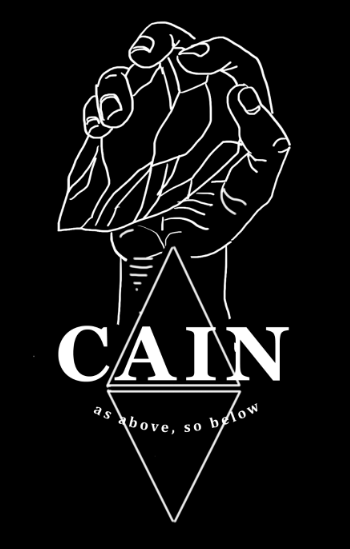
CAIN’s logo. The vertically mirrored triangles appear often as a simplified logo representing the motto, “as above, so below”
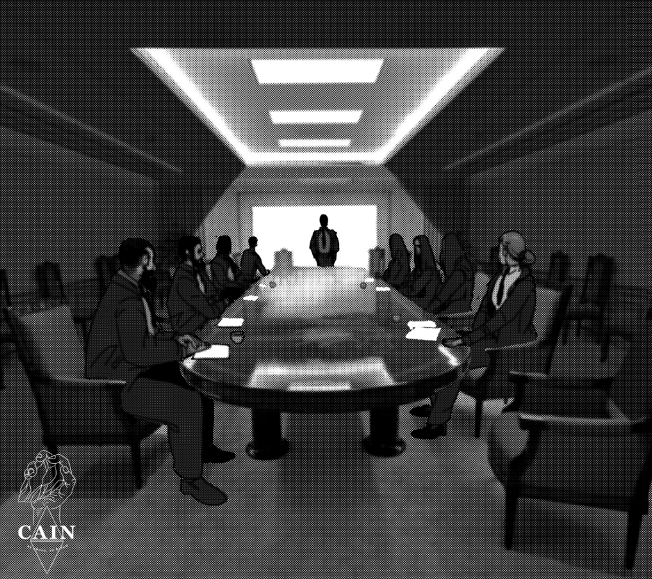
CAIN executives in a meeting
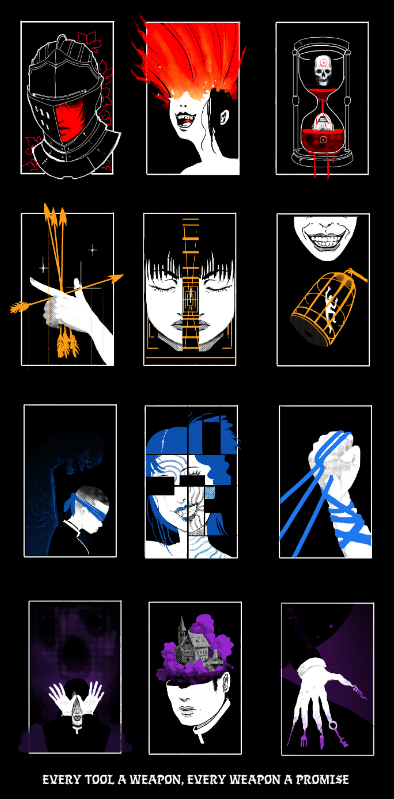
The twelve blasphemies (there are more in Games for Freaks 3 as well as the plethora of homebrew supplements)
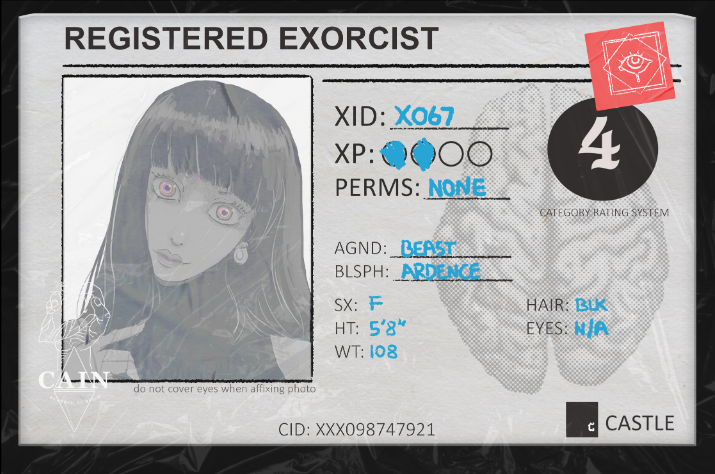
Mogs me
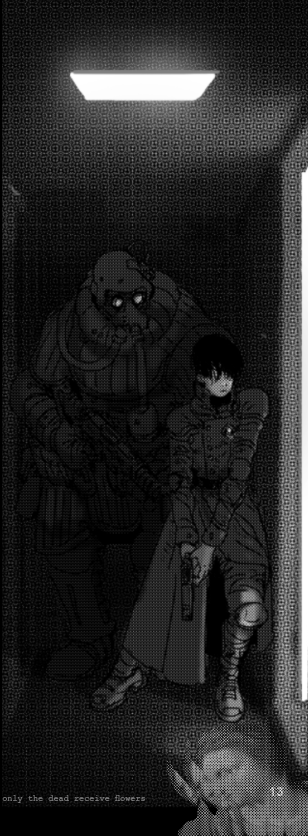
This reminds me a lot of Ghost in the Shell
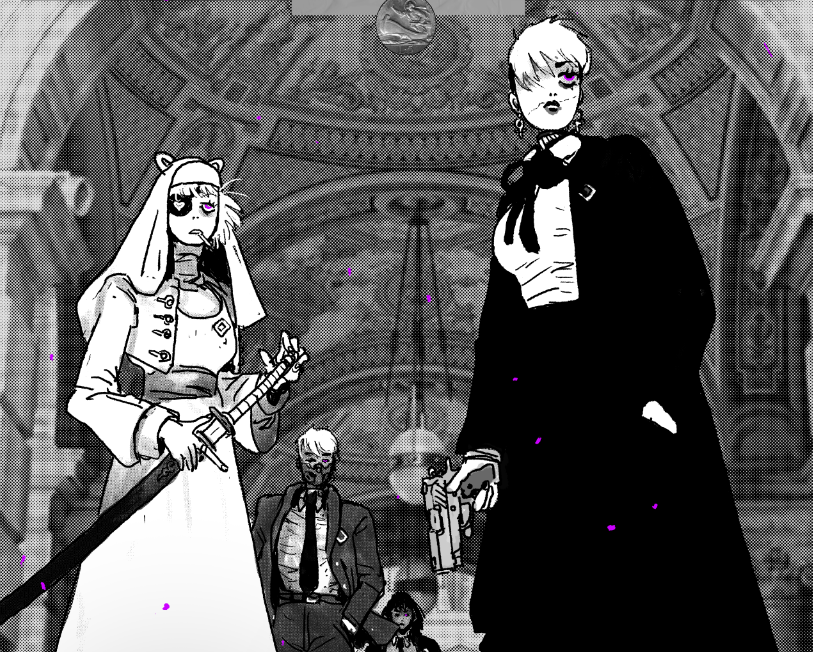
An example of Tom Bloom’s bisexual-targeted character design proclivities
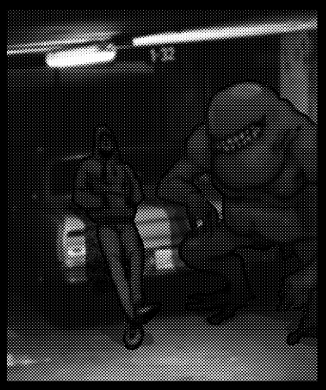
Pockets is a Toad SIN who is actually chill as hell and somewhat uniquely has a criminal partnership with its host
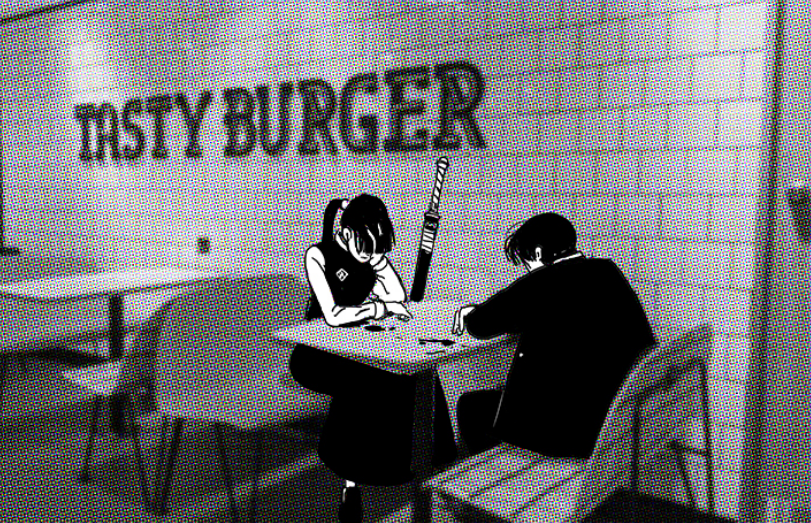
Two exorcists resting during a mission